Quidditch season at Hogwarts starts up each year in November, with matches running through the winter and into the spring. This time of year brings cold, blustery weather to Hogwarts, making for chilly matches for both the players and the fans. The players stay warm in their uniforms, which I wrote all about last week, but what about the fans shivering in the stands?

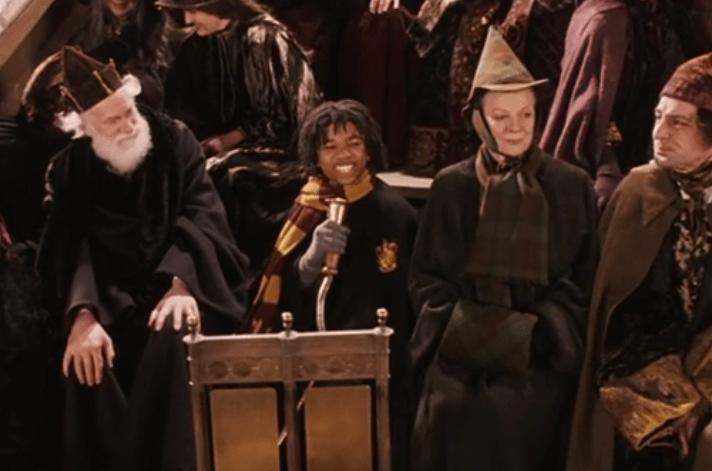
Hogwarts students stay warm and support their teams by donning house scarves in the colors of their houses. These iconic knit scarves have become emblematic of the Harry Potter films. While these scarves aren’t reserved only for quidditch, and we certainly see students wearing them on other occasions, they are undoubtedly most popular in the quidditch stands. The design of the scarves does change slightly over the saga, from blocky, even stripes to a thin double stripe pattern, but the donning of the house scarf remains a popular sartorial choice for Hogwarts quidditch fans.
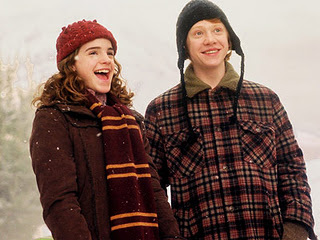
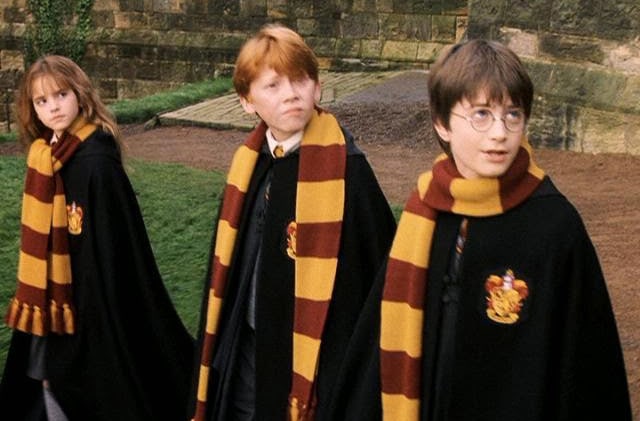


A scarf is a great first knitting pattern. So, if you are giving knitting a try for the first time or you are very new to the knitting, a Hogwarts scarf would be a good project choice. If you are a more experienced knitter, this simple scarf makes great tv knitting!
One thing to consider when knitting a scarf is that knitting has a ‘right’ side and a ‘wrong’ side. When you wear most knitted objects – say a sweater, for example – people only see the ‘right’ side of the knitting. If you take your sweater off and look at the inside, you can see the ‘wrong’ side of the knitting, and it usually looks quite different than the side that is intended to be seen. Most of the time, we don’t wear our sweaters inside out, because the ‘right’ side of the knitting tends to be the more attractive side (although, don’t let me or anybody tell you how to wear your knitwear – I’ve seen fair isle sweaters worn inside out and it looks really chic).
The challenge with a scarf, due to the way that it’s worn, is that both the right and wrong sides are usually visible simultaneously. You wrap it around your neck, and unless you are very careful to always maintain a certain placement of the scarf, either side may be visible at any time (and how can you be expected to have any adventures whilst trying to ensure your scarf is always perfectly situated? Ridiculous.). So, when knitting a scarf, you are going to want to pay attention to what both the right and wrong side of the knitting look like.
Many of the patterns that I found for the Hogwarts scarf instruct you to knit the scarf as a tube. Basically, this makes a double layer scarf that will have stockinette stitch visible on all sides. The wrong side is inside the tube and therefore, not visible. This method makes a thick and warm scarf, but has the downside of requiring double the amount of knitting and a lot of yarn to complete. Here are a few tube scarf patterns:

1. L. Kent 
2. L. Kent 
3. R. Alexandra
- House Scarves – Year 1-2 Scarf by Lauren Kent 2. Hogwarts Scarf by Lauren Kent 3. Harry Potter Prisoner of Azkaban Scarf by Rachel Alexandra
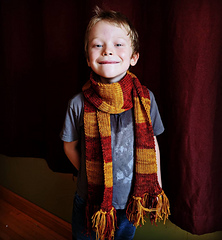
The option I went went with to knit a Gryffindor scarf for my son was the ribbed scarf. I used this pattern: Hogwarts Scarf Mk II by Rachel Alexandra (free!). Ribbing is identical on both sides of the knitting, so it is great for a scarf. I knit my scarf with luxurious Madelinetosh Vintage and it’s soft, warm, and looks great. I used the colors ‘Scarlet’ and ‘Liquid Gold’.
There is also a House Scarf pattern out in the new book Harry Potter Knitting Magic by Tanis Gray (2020). This pattern uses the tubular construction.

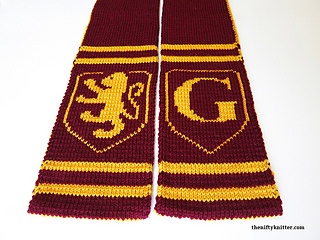
Experienced knitters, you might want to show your house pride by knitting one of these fabulous double knit scarves by Lisa Hannan Fox:


If you are new knitting and taking on a house scarf as one of your first projects, I highly recommend the written knitting tutorials over at Purl Soho: https://www.purlsoho.com/create/category/knit/knit-tutorials/knit-tutorials-basics/ and the videos at VeryPinkKnits: https://www.youtube.com/user/verypinkknits
I taught myself to knit as an adult and those two resources were enormously helpful to me. I still use them when I encounter something new in a pattern or need to refresh some technique I’ve forgotten. I started my knitting journey with a wobbly, little baby blanket and have gone on to knit fair isle and cable sweaters, socks, hats – even a wee pair of toddler pants! You can teach yourself to knit too!
Tell me your Hogwarts house below and what you would wear to cheer your team on (or are you on the team?!)! Also, on scale of 10-10, tell me how much you love McGonagall’s pointy plaid hat.


 Cinema Knits
Leave a comment